
Custom Merch for Small Businesses: The Best Cost-Per-Impression Formats
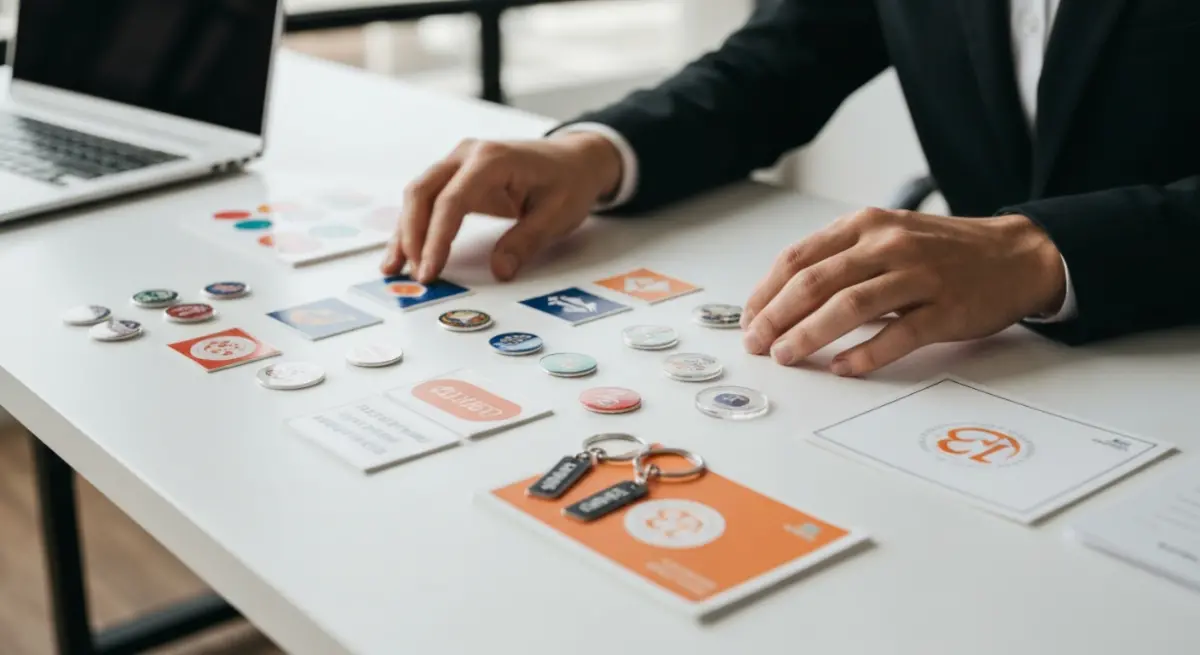
For a small business, custom merch is a distribution decision. It's easy to judge merch by what it costs to produce, but the more useful number is cost-per-impression: how much you spend for each time someone sees your brand, your character IP, or your product out in the world, and that number decides which formats are worth ordering.
Table of Contents
- The metric most small businesses ignore
- Stickers: the lowest barrier, the longest reach
- Badges and pins: wearable visibility at scale
- Acrylic keychains: perceived quality above their price point
- Postcards and prints: the format that travels
- Standees: high-impact, low-volume
- How to choose the right format for your situation
- Who each format serves best
- FAQs
The metric most small businesses ignore {#the-metric-most-small-businesses-ignore}
A poster costs $2 to print and gets seen by the same three people who walk past the wall it hangs on. A badge costs $0.70, gets pinned to a bag, and rides the subway every morning for two years.
Cost-per-impression is a practical production decision. The format you choose sets how many times your brand gets seen, and by how many people beyond the one who bought it.
The formats with the best cost-per-impression share three traits: they are portable, they are durable, and they get displayed rather than stored. Keep those three in mind as you read through the formats below.
Stickers: the lowest barrier, the longest reach {#stickers-the-lowest-barrier-the-longest-reach}
Stickers get dismissed as cheap giveaways, which misses what they do.
A die cut sticker on a laptop, water bottle, or phone case becomes a semi-permanent display surface. It isn't consumed and it isn't filed away. It sits in public, in motion, for months and sometimes years before it fades or peels.
The production economics are simple. At low MOQs, die cut stickers are among the most affordable items per unit in the whole merch catalog, and the unit cost drops further in bulk. Substrate matters here: a sticker printed on a vinyl base with UV lamination resists moisture and abrasion far better than paper-backed alternatives, and that durability directly extends the impression window.
Where stickers fail: when the design is too small to read at a distance, or when the artwork relies on fine linework that loses legibility below 50mm. Your design has to work at the size it will be displayed, not the size it looks good on screen.
Badges and pins: wearable visibility at scale {#badges-and-pins-wearable-visibility-at-scale}
Badges are one of the most underestimated formats in custom merch. They're often taken as niche, suited to fan communities and Artist Alley tables rather than serious brand use, but that undersells them.
A round badge or holographic badge pinned to a jacket, tote bag, or lanyard works like a wearable billboard. It travels with the person, shows up in photos, and gets noticed in queues, at events, and on public transport. That kind of visibility is hard to match with a flyer or a social post.
The unit economics are strong too. Badges start at well under $1 per piece at moderate quantities, and unlike stickers they're reusable: a badge moves from one bag to another, gets repinned, and lasts for years without degrading. That longevity compounds the cost-per-impression advantage.
The main production variable is the finish. A standard gloss badge reads differently from a holographic one. Holographic badges shift color and pattern under light, which pulls attention passively, with no interaction required. For a small business working events or markets, that passive attention is usually worth the small cost difference.
Acrylic keychains: perceived quality above their price point {#acrylic-keychains-perceived-quality-above-their-price-point}
Keychains sit in an interesting spot in the merch hierarchy. They're functional objects rather than purely decorative, which means they get used instead of shelved.
An acrylic keychain travels with its owner every day. Keys go everywhere, and the keychain attached to them goes too. That daily mobility generates passive impressions where other formats can't reach: pockets, bags, car ignitions, desk surfaces.
The perceived quality of acrylic runs well above its production cost. A cleanly printed, double-sided acrylic keychain with tidy die-cut edges reads as a considered, premium object rather than a freebie. That matters for a small business, because it signals you take your brand seriously without a large production budget.
Thick acrylic keychains add weight and rigidity, which lifts the hand-feel further. The difference between a standard piece and a thick one is obvious the moment you hold it, and for products meant as retail items rather than giveaways, that tactile difference changes how buyers value them.
Color accuracy is a known challenge with acrylic. RGB files print differently on acrylic than on paper, because the white base layer and the acrylic itself both affect how colors read. Print files calibrated for acrylic output aren't optional here. They're the difference between a product that matches your artwork and one that ships with visible color deviation.
Postcards and prints: the format that travels {#postcards-and-prints-the-format-that-travels}
Postcards work because they move. A postcard included in an order, handed out at an event, or left on a retail counter gets picked up, carried home, and often displayed: pinned to a board, tucked into a frame, or kept in a drawer for months. That journey generates impressions at several points, not just the moment of handoff.
For a small business, postcards do double duty. They carry artwork or brand imagery on one side and practical information (website, social handle, product range) on the other. They're the most information-dense format in the merch catalog at the lowest cost per unit.
Prints work differently. A poster or art print is a destination object: it goes up in a fixed spot and generates repeated impressions from the same audience over time. The cost-per-impression on a print depends entirely on where it lands. A print in a high-traffic retail space performs very differently from one that goes home with a single buyer.
For small businesses on a tight budget, postcards offer more flexibility. They distribute at scale, ship light, and print in short runs without much of a cost penalty.
Standees: high-impact, low-volume {#standees-high-impact-low-volume}
Standees trade impression volume for impact, and that shapes how you use them.
An acrylic standee or wood standee on a retail counter, market table, or event display draws attention through physical presence: three-dimensional, backlit-friendly, and visually distinct from flat printed material. One standee in the right spot generates concentrated impressions from a targeted audience.
The cost-per-impression math for a standee only works when placement is deliberate. A standee in a storage box generates nothing. Put it at the point of sale or the center of an event table and it earns back its cost many times over.
Thick acrylic standees add weight and stability, which matters at outdoor markets or busy retail spots where lighter pieces get knocked over. The substrate choice here is practical, not just aesthetic.
Standees suit small businesses with a physical presence: a market stall, a pop-up, a retail partnership, a convention table. For a purely online business, the impression value is harder to capture.
How to choose the right format for your situation {#how-to-choose-the-right-format-for-your-situation}
The format decision comes down to three variables: distribution method, audience context, and budget per impression.
| Format | Best distribution method | Audience context | Relative cost-per-impression |
|---|---|---|---|
| Die cut stickers | Order inserts, event giveaways | Mobile, daily-use surfaces | Very low |
| Badges / pins | Retail, events, fan communities | Wearable, public-facing | Very low |
| Acrylic keychains | Retail, conventions, online orders | Daily-use, functional | Low |
| Postcards | Order inserts, counters, events | Portable, informational | Low |
| Prints / posters | Retail display, art sales | Fixed location, repeated exposure | Medium |
| Standees | Point-of-sale, event tables | Concentrated, high-attention | Medium to high |
Stickers and badges don't compete head to head. Match the format to how your audience will run into it.
If your business is mostly online, formats that travel with the buyer (stickers, badges, keychains) create impressions in the physical world your digital presence can't reach. If you work events or markets, standees and prints give you a visual anchor that pulls people toward your table before they've read a word of copy.
Who each format serves best {#who-each-format-serves-best}
- Independent artists and illustrators: badges, die cut stickers, and acrylic keychains. All three carry character IP well, scale from single units to bulk runs, and sell well at Artist Alley and convention tables.
- Small retail brands and product businesses: postcards as order inserts, standees at point-of-sale. Both extend the brand impression beyond the product itself without a large inventory commitment.
- Event organizers and community groups: badges and keychains as event merchandise or attendee giveaways. Both are durable, portable, and keep generating impressions after the event ends.
- Fan communities and IP-driven creators: holographic badges, thick acrylic keychains, and standees. These carry detailed artwork at the quality level fan audiences expect and will pay for.
- Online-first businesses: die cut stickers and postcards as packaging inserts. Both add perceived value to an unboxing and extend brand reach into the buyer's daily environment.
PopEcho handles custom on-demand production from a single piece, with bulk pricing for creators who are ready to scale. It covers the full range of formats discussed here, from die cut stickers and badges to acrylic keychains and standees, with free mockup generation and RGB print file support built into the ordering process. Learn more at popecho.art.
FAQs {#faqs}
What does "cost-per-impression" mean for custom merch?
Cost-per-impression measures how much you spend for each time a person sees your brand through a physical product. A badge worn daily generates far more impressions over its lifetime than a flyer handed out once, even if the badge costs more to produce.
Which merch format has the lowest cost-per-impression for a small business?
Badges and die cut stickers consistently deliver the lowest cost-per-impression. They are durable, portable, and displayed in public rather than stored. A badge pinned to a bag can generate thousands of impressions over its usable life.
Can I order custom merch in small quantities as a small business?
Yes. PopEcho supports production from a single piece, which means you aren't forced into large MOQs before you have validated demand. Short runs are practical for testing formats before committing to bulk orders.
What file format should I use for custom merch production?
RGB files are the standard for digital print production. CMYK is used in offset printing. For acrylic and holographic substrates in particular, a calibrated RGB file prevents color deviation between your screen artwork and the finished product. Always confirm the required color profile with your production partner before submitting files.
Are stickers or badges better for event giveaways?
Both have a place. Stickers are lower cost per unit and easier to distribute in large quantities. Badges have higher perceived quality and generate wearable visibility after the event ends. If your budget allows, using both (stickers for volume distribution, badges as a premium item) covers both functions.
How do I know if a standee is worth the cost for my business?
Standees justify their cost when placement is intentional and foot traffic is consistent. A standee at a busy market table or retail counter generates concentrated impressions from a targeted audience. For online-only businesses with no physical presence, other formats typically offer better cost-per-impression returns.
What is the difference between standard and thick acrylic for keychains?
Thick acrylic keychains have greater physical weight and rigidity, which improves hand-feel and durability. Standard acrylic is lighter and lower in cost. For retail products where perceived quality affects purchase decisions, thick acrylic is the more defensible production choice. For giveaways or high-volume distribution, standard acrylic is usually sufficient.