
Enamel Pins vs Acrylic Badges: How to Choose the Right Format for Your Design
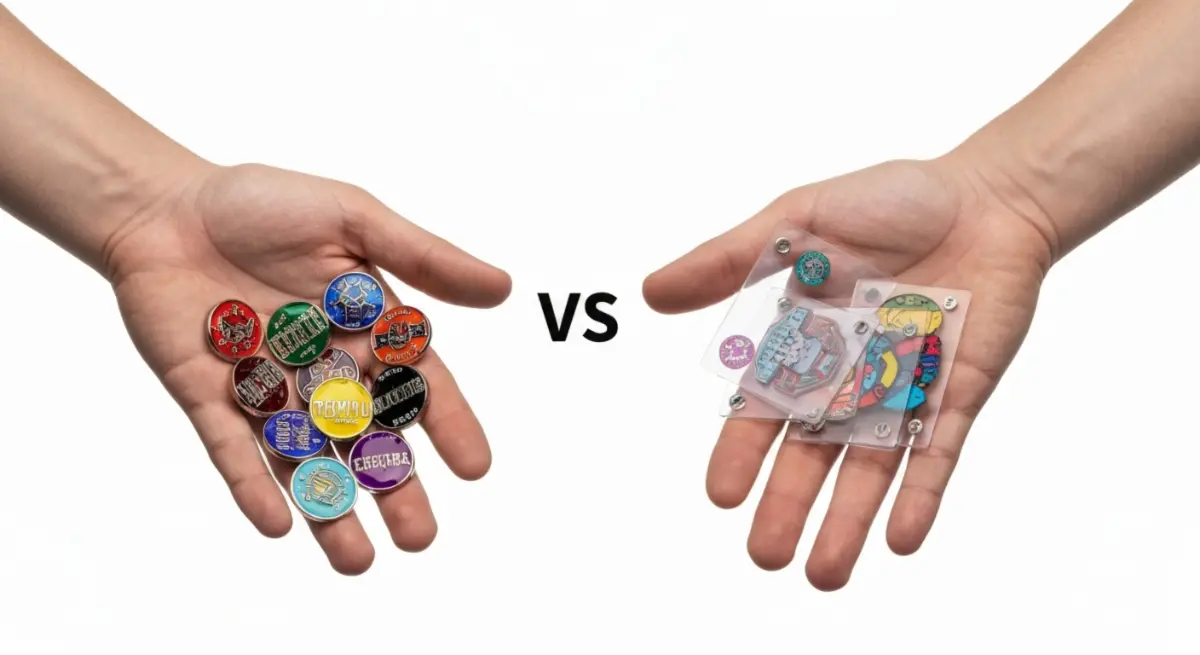
An enamel pin and an acrylic badge start from opposite production methods. An enamel pin is constructed: color fills recessed areas defined by raised metal borders. An acrylic badge is printed: your artwork prints onto or beneath a cut acrylic sheet. That single difference decides which designs each format can reproduce, what they cost, and how many you need to order.
Table of Contents
- How enamel pins are made
- Hard enamel vs soft enamel
- How acrylic badges are made
- Side-by-side: the production differences
- Which format fits your design
- A four-step decision check
- FAQs
How enamel pins are made {#enamel-made}
An enamel pin is a metal-based badge, typically zinc alloy or iron, where color fills recessed areas defined by raised metal borders called metal lines or cloisonné walls. The design is not printed, it is built into the metal.
That method sets clear limits. If your design has gradients, photographic detail, or lines thinner than 0.3mm, the metal walls cannot hold that level of complexity, and detail that looks clean in your vector file gets lost or distorted in the die-cast mold. Enamel rewards bold, flat, well-separated color areas.
Enamel also carries a minimum order floor. Most factories require 50 to 100 pieces per colorway, because the tooling and die-casting setup has to be spread across a run. For a creator testing a new character at a convention, that is a real commitment before you know the design sells.
Color count drives cost directly, since each fill color is a separate step, and pricing climbs noticeably above five or six fills. Metallic finishes such as gold, silver, or black nickel are plating choices applied to the whole metal base, not printed colors, so mixing plating tones across one pin raises the unit cost. Plan for a sampling cycle of two to four weeks: the first sample almost always needs a revision as metal line placement, fill depth, and plating tone shift between your file and the physical piece.
Hard enamel vs soft enamel {#hard-vs-soft}
The two enamel types differ in how the color sits against the metal.
- Hard enamel is filled and polished flush with the metal lines. The surface is flat, smooth, and durable, with a solid hand-feel that reads as premium.
- Soft enamel sits recessed below the metal lines, leaving a tactile ridge. The surface has depth, and colors look slightly more saturated because of the shadow in the recesses, which reads as collectible and handcrafted.
Hard enamel suits clean corporate and membership pieces. Soft enamel suits collector drops, where the texture and depth add to the appeal. Cost between the two is close enough that the look and feel you want is the more useful deciding factor.
How acrylic badges are made {#acrylic-made}
An acrylic badge starts from a printed substrate, usually a UV-printed sheet, cut to shape and finished with a pin backing. The image prints directly onto or beneath the acrylic layer rather than being constructed from metal fills.
That changes which designs work. Gradients, photographic textures, fine linework, and complex shading all print cleanly on acrylic. A character design with a soft watercolor background and detailed highlights is straightforward as an acrylic badge, where the same design would need heavy simplification to become an enamel pin.
Acrylic badges also support very low minimums. At PopEcho, acrylic badge production starts from a single piece, which makes it practical to test a new character at low quantity before committing to a larger run in any format.
Color and detail. UV printing on acrylic works from RGB source files, so build your design in RGB. Submit RGB and PopEcho converts to CMYK with a calibrated profile, which keeps your screen color under control through to print. Some color deviation between screen and print is always a variable, and a well-calibrated process keeps it small rather than eliminating it. Thin details below 1mm can soften depending on print resolution and acrylic thickness, so request a test print if your design relies on very fine lines.
Holographic acrylic adds a prismatic base layer beneath the print. The effect shows in areas with low ink coverage and is suppressed under dense, dark artwork, so it does not apply evenly across every design. Knowing this before you finalize artwork saves a revision.
Durability. Acrylic is not as hard as metal under sustained stress. It can scratch, and it can crack if bent, which matters for daily wear on a bag in high-contact settings. Standard acrylic badge thickness runs 3mm to 5mm; thicker acrylic feels more substantial and resists surface scratching, while thinner acrylic keeps weight down on large-format designs.
Side-by-side: the production differences {#side-by-side}
| Factor | Enamel pin | Acrylic badge |
|---|---|---|
| Design complexity | Limited by metal wall structure | Full print fidelity |
| Gradient support | No | Yes |
| Color count | Affects cost directly | No per-color pricing |
| Minimum order | 50–100 pieces typical | From a single piece |
| Lead time | 3–6 weeks including sampling | 1–2 weeks typical |
| Durability | High, metal base resists impact | Moderate, scratches under friction |
| Hand-feel | Dense, solid | Lighter, smooth |
| Look it signals | Metal, collectible | Illustrated, print-forward |
| Unit cost at low quantity | Higher | Lower |
| Unit cost at scale | Competitive | Competitive |
Which format fits your design {#which-fits}
- Artists with detailed character IP. Acrylic reproduces linework, shading, and color depth without redrawing your art to fit a metal mold.
- Creators testing a new design or working in small runs. Acrylic's low minimum lets you validate a design and demand before committing to a larger order, which keeps unsold stock down.
- Brands and organizations producing metal merchandise. Enamel carries a metal weight and finish that suits membership badges, corporate pieces, and premium limited editions.
- Collector and limited-edition drops. Soft enamel with specialty plating such as black nickel or antique gold gives the tactile depth and metal weight that collectors often look for.
Both formats scale to bulk, and their unit costs converge at higher quantities. Many creators start with acrylic to prove a design, then produce a metal version once a design is an established seller.
A four-step decision check {#decision-check}
Work through these in order.
- Design complexity. Does your artwork use gradients, photographic detail, or lines below 0.3mm? If yes, acrylic reproduces it directly; enamel would need a redraw.
- Quantity and risk. Are you producing fewer than 50 pieces or testing something new? Acrylic's low minimum removes the risk of committing to an untested run.
- Use context. Where will the badge be worn? Daily wear in high-friction conditions favors enamel's metal base; display or occasional wear is fine on acrylic.
- Look and feel. What does your audience expect? Some collector and corporate contexts expect metal; illustration-focused communities are comfortable with acrylic and often prefer its print detail.
FAQs {#faqs}
Can I get my gradient artwork made as an enamel pin?
Not without simplification. Enamel needs solid color fills separated by metal walls, so gradients cannot reproduce in that process. If your design relies on gradient shading, acrylic is the format that holds it.
What is the minimum order for acrylic badges vs enamel pins?
Acrylic badges can be produced from a single piece at platforms like PopEcho. Enamel pins typically require 50 to 100 pieces per design because of the tooling and die-casting setup.
Which format is more durable for everyday wear?
Enamel. The metal base resists impact and does not scratch under normal friction, while acrylic scratches more easily, especially on thinner substrates. For daily bag wear in active settings, enamel holds up longer.
Does holographic acrylic apply to the whole badge surface?
No. The effect shows where ink coverage is low or absent, and dense, dark areas suppress it. Knowing this before you finalize artwork prevents surprises in production.
How long does enamel production take compared to acrylic?
Enamel usually runs three to six weeks including the sampling cycle. Acrylic badges are faster, usually one to two weeks, because there is no tooling or mold stage.
Can I produce both formats of the same design?
Yes, though the enamel version needs a separate file: a simplified, flat-color vector rebuild with metal line placement defined. The acrylic version can use your original artwork.
Comparing formats for your first badge run? See the acrylic badge options and order from a single piece at popecho.art.