
Fan Merch for OC Characters: IP and Production Decisions That Protect Your Work
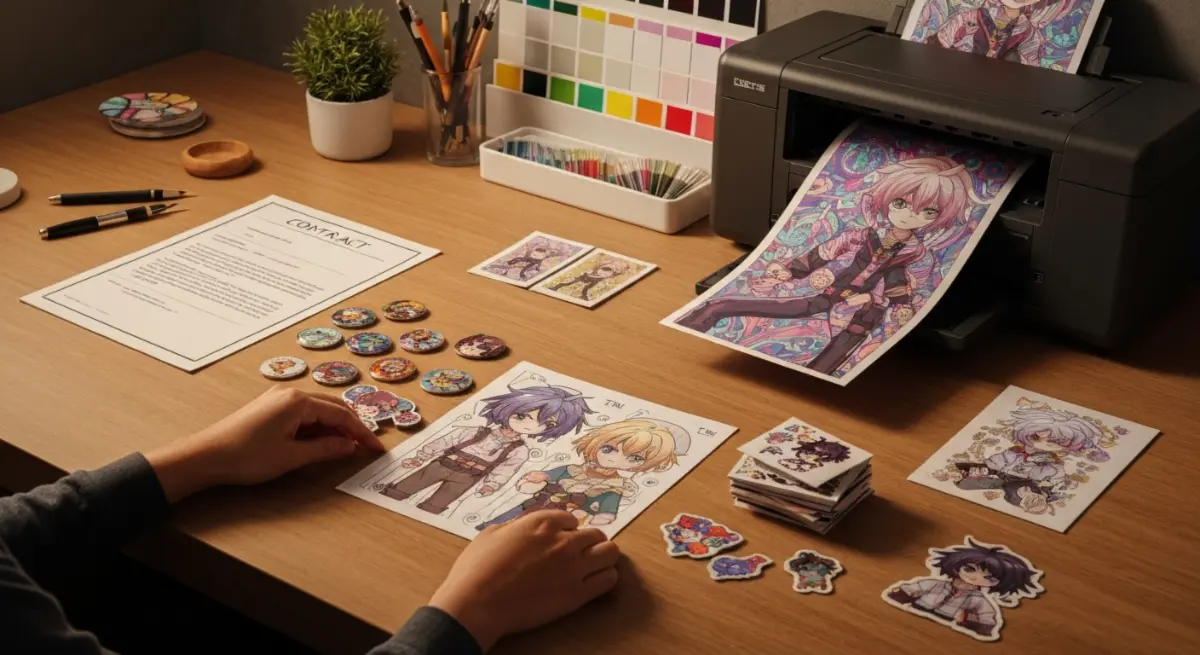
OC merch production is the process of turning an original character's visual identity into physical products that reproduce that identity accurately, at scale, without color deviation or structural failure.
Your OC is intellectual property. You built it, you own it, and it can generate real, repeatable revenue if you treat the production side as seriously as the creative side. That production side is where the expensive mistakes happen.
Table of Contents
- Is your OC protected by default?
- What does OC merch production involve?
- The file mistake that shows up too late
- Which products suit OC art, and which expose weak files?
- Production decisions that protect your design
- Who is OC merch production for?
- FAQs
Is your OC protected by default? {#oc-copyright}
Whether an OC is protected automatically is one of the most common questions I hear from creators heading into Artist Alley or launching a first merch run.
In most jurisdictions, copyright attaches automatically to original creative work the moment you make it. If your OC design is original, it carries that protection with no registration required. But protected and enforceable are two different things.
That gap is where documentation comes in. Dated files, version histories, original sketch layers, and timestamped uploads are your evidence of authorship. If someone reproduces your character without permission, your ability to act depends on your ability to prove you made it first.
The practical takeaway: before you produce a single badge or acrylic standee, build a documentation habit. Keep your source files. Keep your layered PSDs, AI files, or Procreate stacks, and export dated JPEGs at key milestones. It is cheap insurance, and it gives you clean production masters to work from later.
What does OC merch production involve? {#what-it-involves}
The hard part is rarely the drawing. It's the gap between a finished character design and a file a factory can manufacture, and that's where most first-time creators stall.
Why cut paths become a production decision
For acrylic standees, acrylic keychains, or wood standees built from a 2D illustration, the translation from file to product is fairly direct. Your artwork prints onto a flat substrate, and the cut line follows the silhouette.
That changes the moment your OC has overlapping elements: flowing hair crossing the body outline, a weapon held at an angle, a tail wrapping around the figure. The factory cannot cut through the character, so the cut line has to trace the outermost silhouette. You either accept that outline or decide which elements merge into it and which get isolated as separate layers. It is a topology question, not a printing one, and it is yours to resolve before you submit files.
Why your OC's colors shift in print
Your OC was designed on a screen, and screens render in RGB. Printing, whether offset, digital, or UV, outputs in CMYK, and that conversion is not neutral. Saturated blues shift, neon greens flatten, and certain skin tones drift toward orange or gray depending on the press profile.
PopEcho's workflow accepts RGB files and handles the conversion with calibrated profiles, but that is not a reason to ignore it. Proof your colors against a CMYK simulation before you approve production. If your OC's identity depends on a specific color, such as a signature eye color or a distinctive outfit tone, specify it: use Pantone references where you can, and at minimum note the hex values and flag them on submission. Color deviation is the most common complaint on first-run OC merch, and it is also the most preventable.
The file mistake that shows up too late {#file-resolution}
Here is the usual scenario. You have a finished illustration. It looks sharp at 100 percent zoom, you upload it, the mockup preview looks fine, and you approve. The product arrives with soft linework, muddy gradients, and fine details blurred into each other. The cause is almost always resolution.
Screens run at roughly 72 to 96 PPI. Print starts at 300 PPI and goes higher for products with small surface areas, like badges and keychains. A badge face is roughly 58mm across. At 300 PPI, that needs a file of about 685 by 685 pixels at minimum, and most creators submit 500 by 500. It looks fine on screen and prints soft.
For acrylic keychains and standees, the required resolution scales with product size, but the principle holds: your file needs more pixels than your monitor leads you to believe. Check the platform's file specs before you design, not after. PopEcho's free mockup generation helps catch scale issues early, though no mockup can rescue a low-resolution source file.
Which products suit OC art, and which expose weak files? {#product-fit}
Not every format treats your OC equally. Some amplify a strong character design; others expose weaknesses in the artwork that were invisible on screen. Here is how the common formats sort out.
Formats that reward a strong silhouette
- Die cut stickers: the cut line follows the character outline exactly, so a clean, readable silhouette holds even at small sizes.
- Acrylic keychains: the character sits isolated against a transparent or printed background, and solid fills and clean linework reproduce accurately.
- Round and oval badges: the circular frame crops the character, so composition inside the frame matters more than the full-body silhouette.
- Holographic badges: the substrate adds visual complexity, so simpler, bolder designs hold up better than intricate line art.
Formats that need extra preparation
- Acrylic standees: need a resolved cut path, a confirmed bleed line, and a decision on whether the base is part of the artwork or produced separately.
- Wood standees: the substrate is warm-toned, so colors shift against the natural grain and your OC's palette should be tested against the material.
- Shikishi boards: large format, usually for illustration display, where proportion inconsistencies in the original art become visible at scale.
Formats that extend your OC into new contexts
- Postcards and posters: room to present your OC in a scene or narrative, not just as a character sheet.
- Acrylic coasters: functional pieces that keep your character in daily use and in view.
- Glass cups: the print wraps the full cylinder, so your design has to account for the wrap zone and the seam where the two edges of the print meet.
Production decisions that protect your design {#protect-design}
Design integrity is not about aesthetics. It is about making sure what you created survives production intact.
Bleed lines and safe zones
Every product has a bleed zone, the area past the trim line that gets cut away, and anything you place there risks being removed. The safe zone is the inverse: the area inside the trim line where every critical element belongs. Eyes, text, the character name, and signature details should all sit inside the safe zone with margin to spare.
This is easy to know in theory and easy to get wrong in practice: elements get pushed too close to the edge, because the mockup clips the bleed and the error stays invisible until the product ships. For beginners, add 3 to 5mm of safe-zone margin beyond the platform's stated minimum. It costs nothing in production and prevents the most common trim errors.
Finish technique and perceived quality
The finish on a product changes how the character reads, physically as well as visually. A matte laminate on a badge or sticker cuts glare and gives a solid hand-feel. Gloss laminate deepens color saturation but shows fingerprints. A holographic substrate adds iridescence but competes with the artwork when the design is already busy. These are production decisions, not decorative ones. Choose the finish for what it does for your character's identity, not for what looks most impressive in a product listing.
MOQ and dead inventory
MOQ, the minimum order quantity, is the production floor a factory sets. For most OC creators the bigger risk isn't meeting MOQ; it's over-ordering. Order 200 badges of a design you have not tested with an audience and the pattern is familiar: 30 sell, 170 sit in a box, and the capital is gone.
Start with low-quantity runs. PopEcho supports on-demand production from a single piece, so you can test a design at minimal exposure before you scale. Prove demand first, then scale on evidence.
Who is OC merch production for? {#who-its-for}
- Independent artists and illustrators: creators with original character IP who want physical merch without committing to large MOQs or holding inventory.
- Fan community organizers: group buyers or zine coordinators producing OC-based merch for a defined audience, often on tight timelines and with mixed file quality across contributors.
- Webcomic and visual novel creators: creators with established character IP extending their work into merch as a revenue stream alongside digital content.
- Cosplay and convention creators: artists selling at Artist Alley who need products that travel well, display clearly on a table, and survive repeated handling.
- Small creative businesses: studios or solo operators building a product line around original IP, who need production quality that matches the brand they are building.
FAQs {#faqs}
Do I need to register my OC's copyright before producing merch?
Registration is not required for copyright to exist. In most jurisdictions, copyright attaches automatically at the moment of creation. What registration does is strengthen your ability to enforce that copyright if someone reproduces your work without permission. For creators building a product line around original IP, it is worth considering as the IP gains commercial value.
What file format should I use for OC merch production?
It depends on the product. For flat-print products like stickers, badges, and postcards, a high-resolution PNG or TIFF at 300 PPI minimum is standard. For products with cut paths, such as acrylic standees, die cut stickers, and keychains, you also need a vector cut line, usually delivered as an AI or SVG file alongside the print-ready raster.
How do I handle color accuracy for my OC's signature colors?
Specify your character's key colors with Pantone references or hex values, and flag them explicitly when you submit files. Request a color proof if the platform offers one. If your OC's identity depends on a specific color, such as a distinctive skin tone or a signature eye color, test it against a CMYK simulation before approving production.
What is the minimum quantity I need to order for OC merch?
It varies by platform and product type. PopEcho supports production from a single piece for most product categories, which makes low-risk testing possible. If you have not yet validated a design with an audience, starting at the lowest available quantity is the right production decision.
Can I produce merch of an OC that was co-created with another artist?
Co-created IP needs agreement between all rights holders before production. That covers character designs developed collaboratively, OCs that originated in a shared project, and characters where one artist contributed the visual design and another developed the concept. Produce merch of co-created IP only with documented consent from every contributor.
What causes the most common quality failures in OC merch production?
Resolution is the most frequent cause, with files submitted at screen resolution (72 to 96 PPI) instead of print resolution (300 PPI minimum). The second is color deviation from RGB-to-CMYK conversion, especially in saturated or neon tones. The third is cut-path errors on products with complex character silhouettes.
How do I decide which products to start with for a new OC?
Start with formats that reward a strong silhouette and need minimal file complexity. Die cut stickers, round badges, and acrylic keychains are the standard entry points: low cost per unit, easy to test at small quantities, and quick to give you real audience data before you invest in larger-format or higher-complexity products like standees or specialty prints.
The production side of original character merch is where a project builds commercial traction or stalls in a loop of samples that never ship. The IP and file decisions you make before placing an order shape which way it goes.
PopEcho works with creators at every stage, from single-piece test runs to scaled production across multiple product categories. Learn more at popecho.art.