
Custom Cold Drink Glass vs Acrylic Cups for Merch Durability
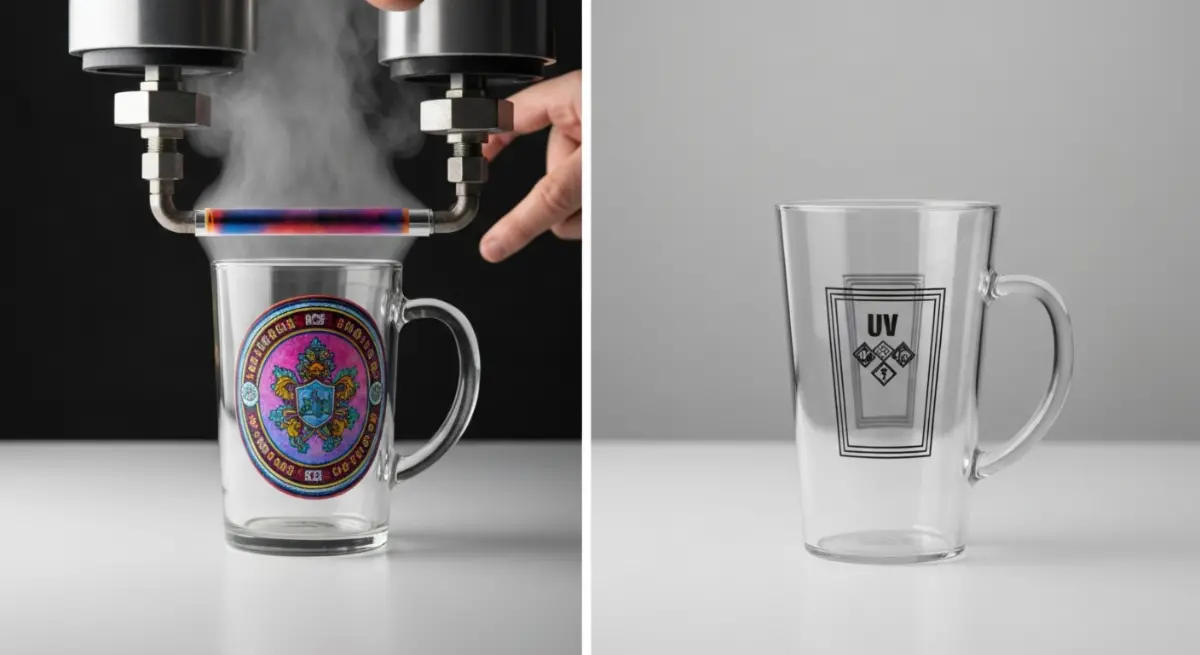
A custom cold drink glass and an acrylic cup are both clear drinkware you can wrap your IP around, but they accept ink in completely different ways, and that difference is what sets how long the print lasts.
Table of Contents
- Why glass and acrylic aren't one category
- How does printing on a cold drink glass work?
- How is acrylic cup printing different?
- Where does durability come from?
- Are printed cups dishwasher safe?
- File preparation: what changes between glass and acrylic
- Who is each format for?
- FAQs
Why glass and acrylic aren't one category {#not-one-category}
Glass cups and acrylic cups look like two versions of the same product, so it is easy to treat them as one category with a material swap. They aren't. The print process for each surface works differently, and that process is what determines how long your artwork survives daily use.
How does printing on a cold drink glass work? {#glass-printing}
Across the wider drinkware market, printing on a glass cup runs on one of two methods: sublimation transfer onto a coated glass surface, or UV printing cured directly onto the glass.
The coated sublimation route is more common at accessible price points. A polymer coating goes onto the glass first, and that coating, not the glass beneath it, is the actual surface the ink bonds to. The design transfers from sublimation paper under high heat, and the dye migrates permanently into the coating. The thing to understand is that the coating is the weak point, not the glass.
UV printing skips the coating. It fires UV-cured ink straight onto the glass, where it sits on top rather than migrating into a layer. Adhesion depends on surface preparation and the quality of the cure cycle. Done well, the result is sharp with strong color saturation. Done badly, with rushed cure time or poor surface cleaning, the ink starts lifting within weeks. PopEcho's own custom cold drink glass is printed as a full-wrap UV job on the bare glass, so there is no coating layer to fail.
For a printed glass cup, durability rides on the coating and the cure, not on the strength of the glass itself.
How is acrylic cup printing different? {#acrylic-printing}
Acrylic does not accept sublimation dye. Its polymer structure is wrong for dye migration, so acrylic cups use UV printing, pad printing, or a combination of the two for complex designs.
UV printing on acrylic produces vivid, high-contrast output, and acrylic's natural clarity amplifies the perceived brightness of the ink. For character IP with bold line work or saturated fills, that is a strong match.
Pad printing handles simpler spot-color designs by pressing ink onto the curved surface with a silicone pad. It manages curves better than a flat UV head but limits you to a small number of colors per pass, which rules it out for full-color illustration.
The durability challenge with acrylic is different from glass. Acrylic scratches. The surface degrades under abrasive cleaning, and once it scratches, the UV ink sitting on top loses adhesion at that point. The ink loses its grip wherever the acrylic underneath has been worn.
This is one of the most common complaints creators raise after their first acrylic drinkware run: the print looks like it has started peeling at the edges. The edges take the most micro-abrasion, because every time the cup is picked up, set down, or dropped into a bag, that is where the contact lands.
Where does durability come from? {#durability}
Both formats share one production truth: durability comes from layer sequencing and surface preparation, not from which material sounds more premium.
For glass:
- Surface cleanliness before coating or cure determines how well the ink keys on
- Coating thickness affects color vibrancy and scratch resistance
- Cure temperature held steady across the full run keeps color deviation between units low
For acrylic:
- Surface texture, matte versus gloss, affects how well UV ink keys into the surface
- Edge finishing quality decides how cleanly the print terminates at the rim and base
- An overcoat or varnish applied after printing extends the ink's surface life noticeably
What decides it is the process behind the print and whether whoever makes it holds each step steady. Choose the process that fits your design, then confirm the printer can repeat it across the run.
Are printed cups dishwasher safe? {#dishwasher}
Creators ask this constantly, and it deserves a straight answer.
Sublimation-coated glass cups are not dishwasher-safe by default. The coating that holds the ink degrades under repeated high-heat wash cycles. The hand-wash guidance exists for a real production reason, not as a legal disclaimer.
UV-printed glass cups with a hardened overcoat hold up better in a dishwasher, but better is relative. Repeated thermal cycling still stresses the bond between ink and glass, and the print fades gradually with use, starting at the highest-contact areas.
Acrylic cups should stay out of the dishwasher regardless of print method, because the material itself warps under dishwasher heat. That is a material limit, not a print limit.
Your buyers will use these daily, so the product description needs to say this honestly. A lot of dead inventory starts with returns from buyers who expected dishwasher durability and got a faded print by month three.
File preparation: what changes between glass and acrylic {#file-prep}
This is where most production outcomes are decided, before a single unit prints.
For cold drink glass:
- Submit in RGB. PopEcho converts to CMYK with a calibrated profile on our end, so a clean RGB file is the reliable default. If you want tight control over out-of-gamut colors, you can convert to CMYK yourself with a target ICC profile before submitting; that is an advanced option, not a requirement. Either way, proof your key colors before a full run.
- Account for the full wrap. A cold drink glass prints as one continuous cylinder, so your artwork needs to tile or resolve cleanly where the wrap meets at the seam. Plan your bleed around that seam.
- Avoid fine line work below 1pt at small sizes. Edges soften slightly during printing, so a line that reads crisp at 300dpi on screen can blur at the seam.
For acrylic cups:
- UV printing on acrylic holds fine detail better. Line work down to 0.5pt is manufacturable on a calibrated UV flatbed.
- Color profiles differ. Acrylic's high gloss amplifies saturation, so colors that look right on screen often print oversaturated. A soft proof against the acrylic profile is worth the extra day.
- If your design wraps the full circumference, confirm whether the print runs on a rotary UV attachment or is applied flat and then curved. The flat-then-curve route introduces distortion at the edges.
If you are preparing files for both formats at once, say for a merch bundle, do not reuse the same file. The color calibration and bleed requirements differ enough that a shared file gives you a suboptimal result on at least one of the two.
Who is each format for? {#who-its-for}
The right format follows the use case.
- Artist Alley sellers and convention creators. A cold drink glass carries higher perceived quality at the point of sale, since buyers associate glass with permanence. Above roughly an $18 price point, glass supports the positioning.
- Fan communities and IP-based merch. Acrylic cups handle full-color character art with high contrast and clarity. For bold, saturated IP, acrylic's UV output often reads sharper than a coated glass print.
- Event organizers and branded gifting. A cold drink glass reads as the more considered gift, while acrylic reads as casual and everyday.
- Small-batch test runs. A custom cold drink glass is available from a single piece at popecho.art, which removes the MOQ barrier that used to make drinkware sampling impractical for independent creators.
- Creators weighing the two formats. They sit at different price points in the market: a printed glass cup reads as a flagship drinkware piece, while acrylic cups are the lower-cost, everyday tier. Match the format to how the piece will be used and sold.
FAQs {#faqs}
What is the difference between sublimation and UV printing for a custom glass cup?
Sublimation transfers dye into a polymer coating applied to the glass. UV printing cures ink directly onto the glass with ultraviolet light. Sublimation gives softer gradients; UV gives sharper edges and higher contrast. Durability depends on process control either way: coating quality for sublimation, cure consistency for UV.
Are custom printed glass cups dishwasher safe?
UV-printed glass cups, the full-wrap route PopEcho uses, hold up better than coated ones but still fade gradually with frequent dishwasher use, because thermal cycling stresses the ink-to-glass bond over time. Sublimation-coated cups fare worse, since the coating that holds the ink degrades under repeated high-heat cycles. Hand washing extends print life for both.
Why does acrylic cup printing scratch more than glass?
Acrylic is softer than glass and more open to micro-abrasion from handling and cleaning. UV ink sits on the surface rather than migrating into the material, so when the acrylic scratches, the ink above that point loses adhesion. The surface under the ink wears first.
Can I use the same artwork file for both a glass cup and an acrylic cup?
Not without adjustment. Glass printing works best from RGB and accounts for edge softening at the seam. Acrylic UV printing holds finer detail but needs color-profile adjustment for the surface's high saturation. One file for both produces a color mismatch on at least one product.
What file resolution do I need for a custom glass cup?
300dpi at final print size is the baseline for a printed glass cup. For UV printing on acrylic, 300dpi is also the baseline, but the process resolves fine detail more accurately, so line work that would soften on glass stays sharp.
How do I prevent color deviation across a print run of glass cups?
For sublimation-coated glass, deviation comes from inconsistent cure temperature across units, so even, calibrated heat helps. For UV printing, consistent cure across the run does the same job. At volume, ask whether the run uses a controlled conveyor process or a manual press, since controlled systems repeat more reliably.
At what quantity does drinkware merch become cost-effective for independent creators?
On-demand production has mostly removed the old MOQ barrier, so single-unit orders are now manufacturable for both glass and acrylic. Unit cost drops meaningfully around 50-plus pieces, but production quality does not change between a 1-piece and a 100-piece run when the process is properly calibrated.
PopEcho produces custom cold drink glass with calibrated full-wrap UV printing and color management. Production standards, file requirements, and product specs are documented at popecho.art.