
Collectible Card File Prep: Laminate Choice and Color Fidelity
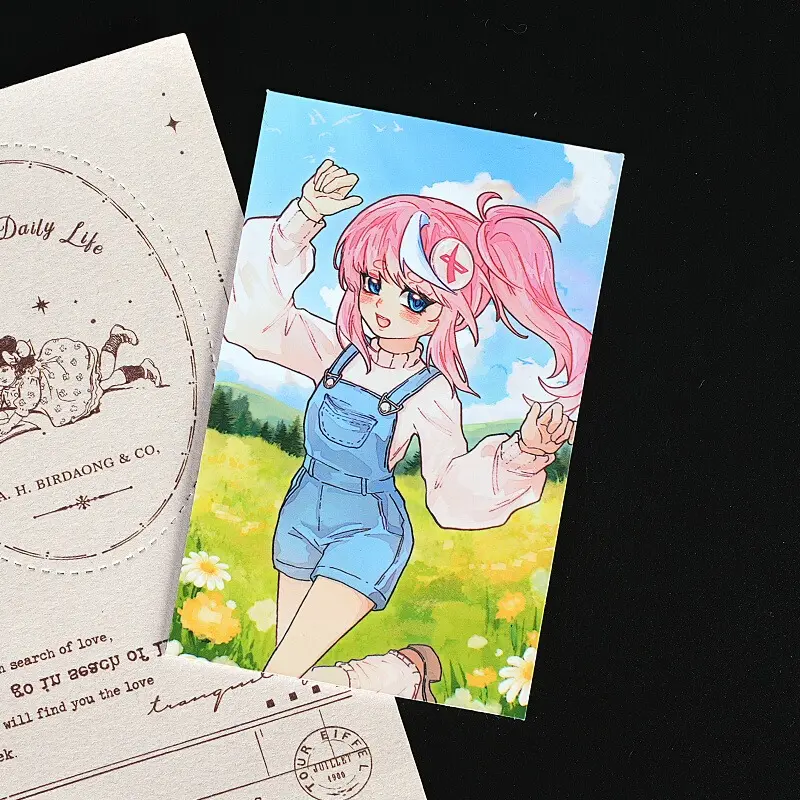
Collectible Card File Prep: Laminate Choice and Color Fidelity
How the 16-color wide-gamut process and seven finish options shape every production decision.
TL;DR
Popecho's collectible card prints on 400gsm coated art paper in two sleeve-ready sizes — 86×54mm or 87×62mm — using a 16-color wide-gamut process that reproduces saturated illustration palettes without compression. The decision that shapes the final result most is laminate finish: seven options change perceived color depth, texture, and surface drama. Lock your finish before sharing mockups, build artwork at 300 DPI in RGB with 2mm bleed, and open the product in Popecho's editor to let the safe-zone overlay confirm your critical elements are clear of the cut.
What This Subtype Actually Demands
A collectible card lives in a sleeve, gets handled repeatedly, and gets compared directly to officially printed idol cards and high-end doujin merch sitting next to it in a binder. That comparison pressure is where this format earns or loses credibility. Popecho's 16-color wide-gamut process targets exactly that standard — not as a premium add-on, but as the fixed print baseline on every order. What this means in practice: color fidelity is the primary promise, and every upstream decision you make — substrate, laminate, bleed handling — either supports or undercuts it. The second structural fact is that seven laminate SKUs run on the same 400gsm coated art paper core, which means the finish choice is a distinct variable that has to be locked early, not left to the last step before checkout.
Setting Up the Artwork
Both size variants need artwork built with 2mm bleed on every edge: that gives you an 88×56mm canvas for the 86×54mm standard card and an 89×64mm canvas for the 87×62mm tall format. Work at 300 DPI minimum and keep your color mode in RGB — the 16-color wide-gamut output is calibrated to RGB source files, and pre-converting to CMYK before upload compresses the tonal range the process is designed to preserve.
Popecho's onsite editor loads a double-view canvas for this product, so you set up both the front and back surfaces in a single session. Front and back have different roles: the front carries the primary illustration or character art with full bleed and safe-zone discipline, while the back typically holds edition text, set information, or a secondary graphic at lower visual weight. Inside the editor, the safe-zone overlay snaps into place automatically — keep all critical text and face details at least 2mm inside the cut line, and you can use the editor's live preview to screenshot a finish mockup for Kickstarter or campaign pages before committing to print.
Accepted formats are PNG, JPG, and PSD. The editor flags resolution or color-mode issues at upload so you can correct before confirming.
Surface and Production Decisions
The laminate finish determines how the 16-color output reads at arm's length and in-hand. High-gloss (高透亮膜) maximizes color vibrancy and gives the card the mirror-bright look associated with commercial trading cards. Matte (哑膜) and soft-touch (触感膜) both slightly desaturate perceived color — if your artwork relies on vivid saturation, consider compensating with a small boost before upload or switching to a gloss-family finish. Holographic foil (镭射膜) and holographic stars (镭射星星) reduce apparent saturation in dark areas; designs with deep shadow regions and fine highlight details may lose contrast in those zones.
Embossed gloss (浮雕亮面) adds a micro-texture emboss over the print surface. It reads beautifully on large illustration areas but can soften crispness in small-text passages — reserve this finish for art-heavy layouts rather than info-dense backs. Starfield glitter (满天星) carries no price surcharge at volume, but like the laser finishes, confirm its availability against your chosen size in Popecho's editor before finalizing artwork — finish-to-size pairings are variant-level selections, and the 87×62mm tall card should be verified inside the editor before committing that canvas to a laminate option.
Production lead time is 7 days. MOQ is 20 pcs per design, which makes a small first run a practical proof before scaling. Orders of 500 or more units move to Popecho's bulk custom pricing route.
What Trips Creators Up
Uploading a CMYK-converted file. The 16-color engine is built for RGB source data. A CMYK pre-conversion narrows the tonal range before the process even starts, and the vivid palette that made the artwork worth printing gets compressed at the source. Keep the file in RGB until upload.
Assuming all finishes are available on both sizes. The 87×62mm tall card has confirmed finish pairings that differ from the 86×54mm standard. Open the product in Popecho's editor and select your size first — finish options resolve to what's actually available for that variant.
Leaving the back canvas blank or generic. The editor surfaces front and back as separate views. A blank back is a missed opportunity: edition number, set name, or a secondary character element turns a single card into a collectible object rather than a sticker on cardstock.
Hairline rules and fine type below 0.25pt. The 400gsm coated surface handles fine detail well, but rules thinner than 0.25pt are at risk of breaking at this scale and size. Check small text at 100% zoom before upload.