
Bulk Merch Orders: Which Run Size Lowers Unit Cost?
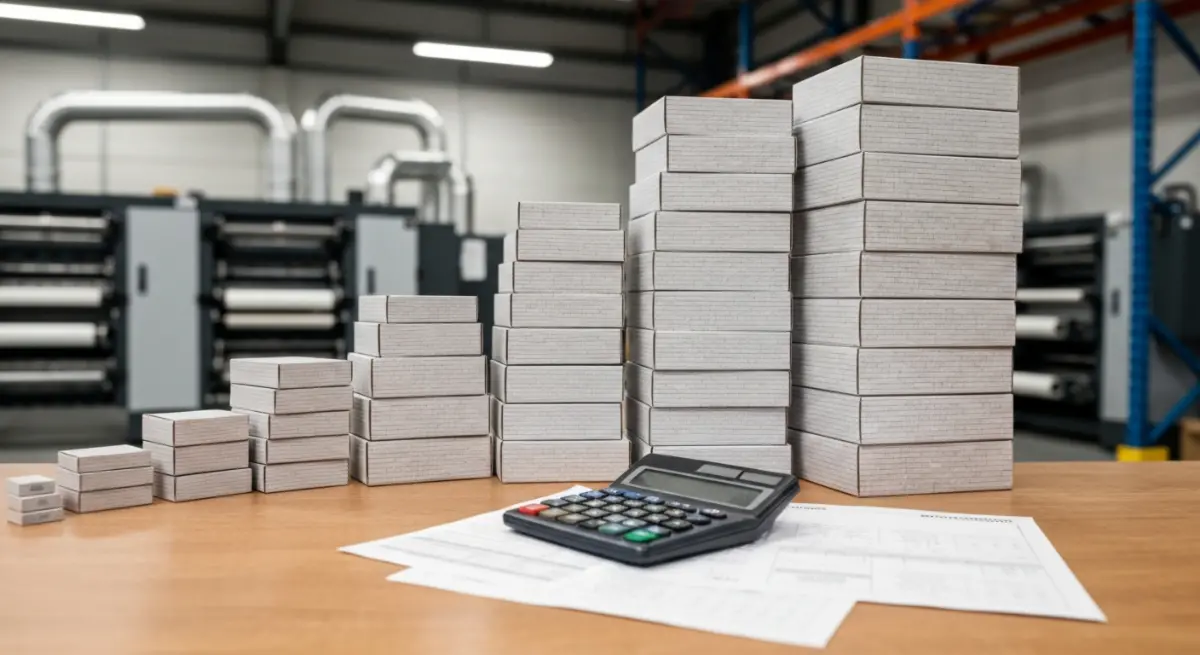
A bulk merch order is a single production run large enough that its fixed setup cost gets divided across many units instead of a few. That division, not a sale-style discount, is what pulls the per-unit price down. Read the pricing the wrong way and you either overpay on tiny runs or over-order and sit on stock you can't move.
Table of Contents
- What sets the per-unit price
- How print run economics work
- Product-by-product breakdown
- Where the math changes: the 50-unit threshold
- MOQ vs the optimal run size
- How to calculate your break-even
- Who should order at which tier
- FAQs
Ordering more does lower the per-unit cost, but the useful question is where the drop becomes big enough to matter, and the answer moves with product type, substrate, and finishing method. Get it wrong and you either overpay on a small run or end up with dead inventory from over-ordering.
What sets the per-unit price {#the-assumption}
It's easy to treat bulk pricing like a store sale: a 10 percent discount at 50 units, 20 percent at 100. Production economics don't work that way.
The main driver of unit cost is setup cost amortization. Every run carries fixed overhead: plate setup, die cutting calibration, film output, machine prep. That overhead is the same whether you print 10 units or 1,000. What changes is how many units share it.
So the lower per-unit price comes from dividing that fixed cost across more pieces, not from a discount that switches on at a magic number. Once you see it that way, you plan every order around it.
How print run economics work {#run-economics}
Why setup costs dominate small runs
For most merch products, badges, acrylic standees, and die cut stickers among them, setup cost is a real, concrete number. It covers tooling, machine configuration, and the first-pass waste any calibrated run produces.
On a run of 10 units, that fixed cost might be 40 to 60 percent of your total unit price. On a run of 500 units, it drops below 5 percent. Printing cost per unit barely moves; the setup cost per unit is what collapses as the run grows.
That's why the unit price curve is steep at the low end and nearly flat at the high end. The dramatic drops happen early, between 10 and 100 units, not at 500.
The cost tiers worth knowing
Based on real production experience, the meaningful thresholds for most merch categories fall into a few bands:
- 1 to 25 units. Setup cost dominates and unit price is high. This tier is for sampling, proofing, and Artist Alley test runs, not commercial production.
- 50 to 100 units. The first real drop. Setup cost is now a minor fraction of the total. This is where bulk pricing becomes commercially workable for most creators.
- 200 to 500 units. Material cost becomes the main variable and unit prices stabilize. Negotiating substrate upgrades or finishing at this tier often costs less per unit than you'd expect.
- 500+ units. Gains from quantity alone are small. The savings here come from production scheduling, consolidated shipping, and substrate sourcing rather than run size itself.
Product-by-product breakdown {#product-breakdown}
Those tiers are general. Each category has its own cost structure, so here's how the math shifts.
Stickers and die cut products
Die cut stickers carry a real die setup cost. On runs under 25 units it's significant. At 50 units it becomes manageable. At 100 it's negligible.
The substrate, meaning vinyl weight, laminate type, and adhesive grade, affects unit cost more than most creators realize. A premium laminate adds a fixed material cost per unit, not a percentage, so it becomes proportionally cheaper at higher quantities.
Bleed lines and cut path complexity also add to setup time. A simple shape at 100 units costs less per unit than a complex shape at 100 units. Complexity has a price, and it doesn't dilute the way setup costs do.
Badges and pins
Badges follow a similar curve, but setup costs run higher, especially for holographic badges, which need extra film layers and calibrated registration. The cost drop between 25 and 100 units is steeper for holographic variants than for standard round or oval badges.
For standard round badges, 50 units is where the price turns competitive. Below that, you're paying a premium for the small run.
Pin products with metal components carry higher tooling costs still. For metal-backed badges, the economically rational minimum is usually 100 units. That's not a fixed rule; below that point, tooling amortization makes the unit price hard to justify commercially.
Acrylic standees and keychains
Acrylic products, including standees, keychains, and thick acrylic variants, involve laser cutting or CNC routing. Setup cost is lower than for print-heavy products, but material cost per unit is higher.
The result is a flatter unit price curve. You won't see the sharp drop between 10 and 50 units that stickers show. Savings are more gradual and depend on sheet utilization, meaning how efficiently your design nests on the acrylic sheet during cutting.
A design that tiles poorly wastes substrate. That waste is a real cost, and it scales up with quantity rather than disappearing. If you're starting out, optimize your cut file for nesting before you finalize a run size.
Prints and postcards
Offset printing, used for high-volume poster and postcard runs, has the steepest setup cost curve of any category. Plate setup, color calibration, and press prep are expensive. On runs under 100 units, digital printing is almost always the better call.
The crossover point, where offset becomes cheaper per unit than digital, usually falls between 200 and 500 units depending on color count and substrate weight. Below that, digital printing on a calibrated press delivers comparable quality at a lower total cost.
Color deviation is also better controlled in digital runs at low quantities. Offset at low volumes often shows more variation between sheets, because offset is calibrated for long runs, not short ones.
Where the math changes: the 50-unit threshold {#the-50-unit-threshold}
Across most merch categories, 50 units is the first threshold where bulk pricing looks meaningfully different from single-unit pricing, and it starts there rather than at 100 or 200.
Below 50, you're absorbing setup costs at a rate that makes commercial resale hard without high retail margins. Above 50, the unit economics shift enough to support realistic Artist Alley pricing, online store margins, or event bundle pricing.
The 100-unit threshold matters too, for a different reason. At 100 units you get access to material and finish upgrades that aren't economical lower down. A matte laminate, a spot UV finish, a heavier substrate: these become affordable additions at 100 units in a way they simply aren't at 25.
MOQ vs the optimal run size {#moq-vs-optimal}
This is one of the most common points of confusion I see from new creators. MOQ, the minimum order quantity, is the floor. It's the smallest run a factory will accept, and it isn't a recommendation.
Your optimal run size comes from your sell-through rate, your storage capacity, and your margin requirements, not from what the factory will take.
Ordering at MOQ when your sell-through supports 200 units means you'll reorder sooner, pay setup costs again, and land on a higher blended unit cost than if you'd ordered right the first time. Ordering 500 units when your sell-through supports 50 means dead inventory: product that ties up capital and storage without earning anything back.
The decision that matters is which quantity gives you the lowest total cost of goods across your expected sales cycle, not the factory minimum.
How to calculate your break-even {#break-even}
The calculation is straightforward. You need three numbers:
- Total production cost at your target run size: unit cost multiplied by quantity, plus setup fees, shipping, and import duties.
- Your retail price per unit.
- Your expected sell-through rate: the percentage of the run you realistically expect to sell.
Divide total production cost by expected units sold. That's your true cost per unit sold, not the unit price on the quote sheet.
If your retail price doesn't cover that number with a margin that justifies your time and risk, you have three levers: raise the run size to lower unit cost, raise your retail price, or reduce product complexity to lower setup costs. None of these is automatically right. Which one fits depends on your margins, your storage, and how fast the design sells.
PopEcho supports orders starting from a single unit, so you can proof a design before committing to a commercial run. That helps when you're working out break-even on a new character IP or an untested format: you can validate demand at 1 to 10 units before locking into a 100-unit commitment.
Who should order at which tier {#who-orders-what}
- Artists and illustrators at Artist Alley: 50 to 100 units per design. Enough to catch the first real cost drop, small enough to avoid dead stock if a design underperforms. Test new characters at 25 units before scaling.
- Fan communities and group orders: 100 to 200 units. Group orders benefit from consolidated shipping and the material upgrade threshold. Coordinate pre-orders to confirm demand before production.
- Small online stores and Etsy sellers: 50 to 100 units for proven designs, 25 units for new releases. The goal is a repeatable reorder cycle, not one large run.
- Event organizers and convention vendors: 200 to 500 units for anchor products. At this tier, finish upgrades become cost-effective and per-unit shipping costs drop noticeably.
- Brands and IP holders scaling a catalog: 500+ units for core SKUs, with smaller runs for limited or seasonal variants. Here, production scheduling and consolidated logistics matter more than run size alone.
FAQs {#faqs}
At what quantity do bulk merch order prices drop significantly?
The first meaningful drop lands around 50 units for most categories. Below that, setup costs dominate the unit price. The second notable threshold is 100 units, where material and finish upgrades become cost-effective.
Is MOQ the same as the best quantity to order?
No. MOQ is the factory's minimum, not a production recommendation. The optimal run size depends on your sell-through rate, storage capacity, and margin requirements. Ordering at MOQ when demand supports more results in a higher blended unit cost over time.
Why does unit price drop so sharply between 10 and 100 units but flatten after 500?
The sharp early drop reflects setup cost amortization: fixed setup costs spread across more units, so each unit absorbs less overhead. After 500 units, setup costs are already negligible, and material cost, which scales linearly, becomes the primary variable.
Do different product types have different break-even thresholds?
Yes. Holographic and metal-backed badges carry higher tooling costs and usually need 100 units to reach commercial viability. Acrylic products have a flatter cost curve. Offset-printed posters and postcards have a crossover point, where offset becomes cheaper than digital, that falls between 200 and 500 units.
How does design complexity affect bulk pricing?
Complexity affects setup costs, not material costs. A complex die cut path or a multi-layer holographic design raises setup time and first-pass waste. That cost stays a fixed addition to your total regardless of quantity, so it doesn't dilute the way run-size savings do.
Can I order a small test run before committing to a bulk order?
Yes. PopEcho supports production starting from a single unit, so you can proof a design and validate demand before committing to a commercial run. This is the practical approach for a new character IP or an untested product format.
What's the best way to reduce unit cost without increasing run size?
Simplify your cut path, reduce substrate complexity, or consolidate multiple designs into one production run. Nesting several designs on the same sheet, especially for acrylic products, improves sheet utilization and cuts per-unit material waste without a larger total quantity.
PopEcho supports orders from a single unit, so you can proof a run size before you commit to it. Learn more at popecho.art.